Cloud or not cloud? What your accountant is not telling you
Balanced comparison between cloud and on-premise: hidden costs, confidentiality, Internet dependency. Three questions before you sign.
 Souveraineté
“We’ll go with the cloud solution, it’s simpler.” We hear that ten times a month in meetings. It is rarely wrong. But it hides three questions a sharp accountant would ask before you sign.
Question 1: what happens when your Internet goes down?
For 80% of the SMEs we meet, the honest answer is: “we lose half the day”. Cloud tools, mail, document access, ERP — everything goes through the Internet pipe.
A four-hour carrier outage happens. Twice in 2025 at firms we follow. For eight people stopped, that is half a day lost — and the bill runs into the thousands, every incident.
A local solution — on a workstation, a server, or both — keeps running. You read your documents, work your summaries, prep your meetings. The Internet comes back when it comes back.
Question 2: who pays to store your data for the next 10 years?
Cloud pricing looks nice on the first invoice. Less nice on the tenth.
Real case: a law firm storing 250 GB of documents (not much) with a local cloud vendor. Initial cost advertised: a few tens per month.
Three years later, after two price hikes (small but real), a mandatory plan change to keep a feature, and three extra users for growth, the bill had more than quadrupled (+337%).
Compare that to a Mac mini, an AroBox sized on quote, and controlled tariff dependency — without US SaaS price hikes imposed on you.
Question 3: what is your exit strategy?
Nobody asks this. It is by far the most important.
A cloud vendor can, overnight:
- Raise prices (regular — Microsoft, Google, Adobe all did)
- Change terms (OpenAI in 2024 on data collection)
- Freeze your account on automated reports (several Google Drive accounts deleted in 2023 with no notice)
- Shut down (several European SaaS vendors between 2022 and 2025)
In all these scenarios, the question is not “will it happen?”, it is “what do I do when it happens?”.
With a solution where your documents and index stay on a box at your premises — like AroBox — the answer is: “I have the machine, I have the data, I have the docs, and we contracted continuity”. With cloud, the honest answer is often: “I hope exports work”.
An honest reading grid
| Cloud SaaS | On-premise | |
|---|---|---|
| Initial setup | almost zero | a workstation + a box |
| Annual cost after 3 years | who knows | predictable |
| Offline availability | 0% | 100% |
| Confidentiality | depends on contract | total |
| Vendor lock-in | high | lower (data with you) |
| Updates | imposed | chosen |
| Physical maintenance | 0 | a little |
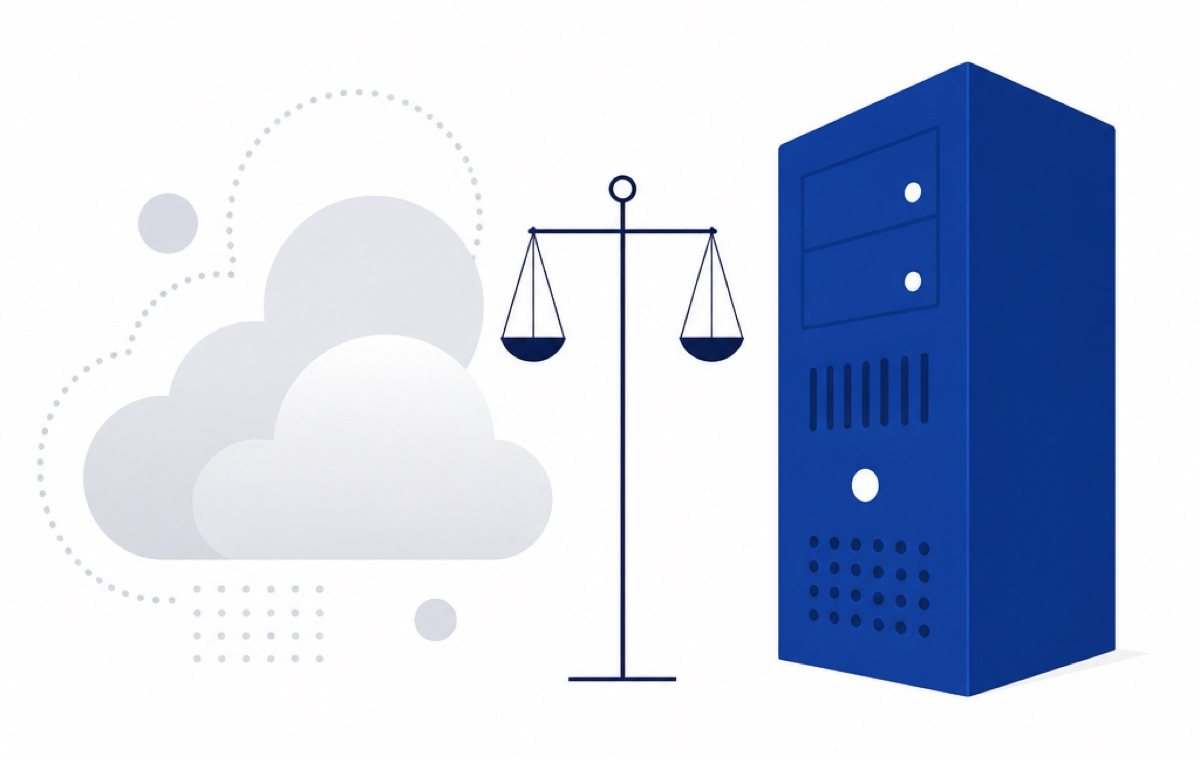
Both models have their place. Cloud remains the best answer for 70% of non-strategic tools (office suite, calendars, messaging). On-premise is mandatory for the 30% that touch your most sensitive data.
And generative AI falls squarely in that 30%.
Let’s talk — we look at your case and tell you honestly whether it makes sense for you.
15-day trial
See AroBox on your real documents
No commitment. We’ll tell you honestly if it fits your business.
Request a trial